
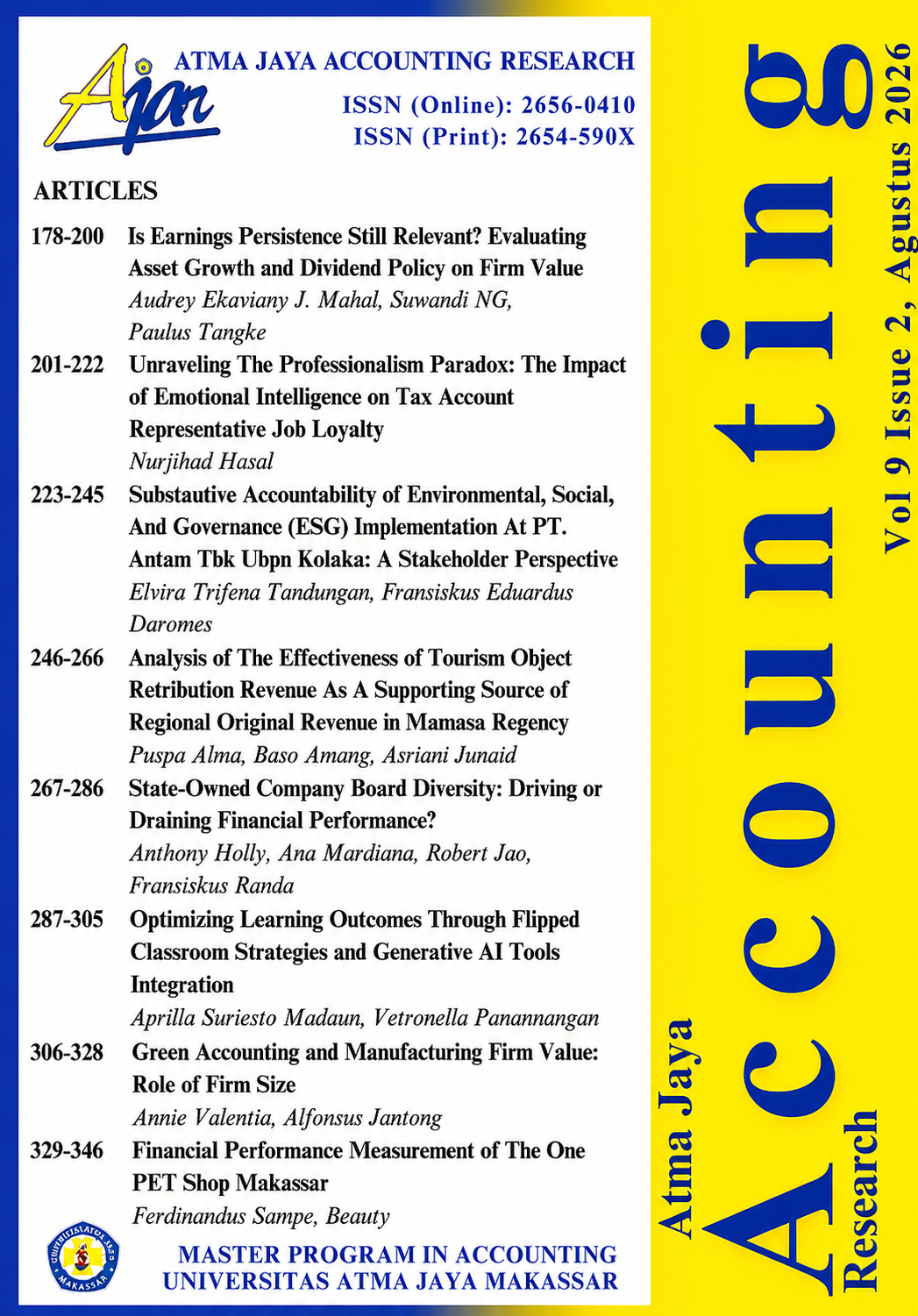
UNRAVELING THE PROFESSIONALISM PARADOX: THE IMPACT OF EMOTIONAL INTELLIGENCE ON TAX ACCOUNT REPRESENTATIVE JOB LOYALTY
Article Sidebar
Main Article Content
Abstract
This study aimed to investigate the influence of emotional intelligence (EQ) on employee job loyalty, mediated by professionalism and integrity. The population was all employees at the Pratama Tax Service Office in South Sulawesi, with account representatives as the primary respondents. Respondent selection was conducted using a purposive sampling method. The results showed that individuals with higher levels of emotional intelligence (EQ) tended to demonstrate more consistent professional behavior in carrying out their duties, manage their emotions well, and remain calm and focused when facing pressure or challenges, while remaining loyal to their work. However, this study found that professionalism had a negative and not significant influence on job loyalty. Future research should consider using a questionnaire with a scale of 1 to 7 for each variable studied and expanding or changing the research object, not only examining Account Representatives (ARs) but also examining functional auditors who may have similar duties and responsibilities regarding state revenue but have different work processes and standards.